

The Art of Dressing a Museum: Flora McFarlane’s Return to the Garden at the Burrell Collection
Words by Kyra Saint Clair and Charlotte Lewis
There are fashion shows, and then there are moments where fashion, place, and people seem to dissolve into one another entirely. What unfolded at the The Burrell Collection felt less like a traditional runway presentation and more like the beginning of a cultural conversation, one rooted deeply in Glasgow, in craftsmanship, and in the enduring spirit of Glasgow School of Art.
The room itself was alive long before the first model emerged. The audience was packed with GSA alumni, photographers, makers, collaborators, and friends, a creative ecosystem gathering around one of its own. It was the first runway show the Burrell has ever hosted, and there could not have been a more fitting debut. Beneath the museum’s soaring glass ceilings, with natural light flooding the space, the entire experience felt immersive and cinematic, as though the garments belonged not simply on bodies, but within the architecture itself.
At the centre of it all was Flora, whose collection carried the confidence of a designer already building a world far beyond graduation. Only two years out of university, she has continued to evolve the ideas first explored in her fourth-year collection at GSA, an achievement that feels increasingly rare in a fashion landscape obsessed with immediacy over development. That continuity gave the show emotional weight. This was not a disconnected new chapter, but a refinement of a language she has already begun to master.
The opening look set the tone immediately. Flora’s now-signature golden knitted dress, originally the closing look from her GSA graduate collection, returned once more. Heat-pressed gold fused onto knitwear transformed the piece into something almost sculptural, her pièce de résistance reintroduced in a new context. Against the Burrell’s vast interiors, the dress felt less like clothing and more like an artefact pulled from the museum’s collection itself.
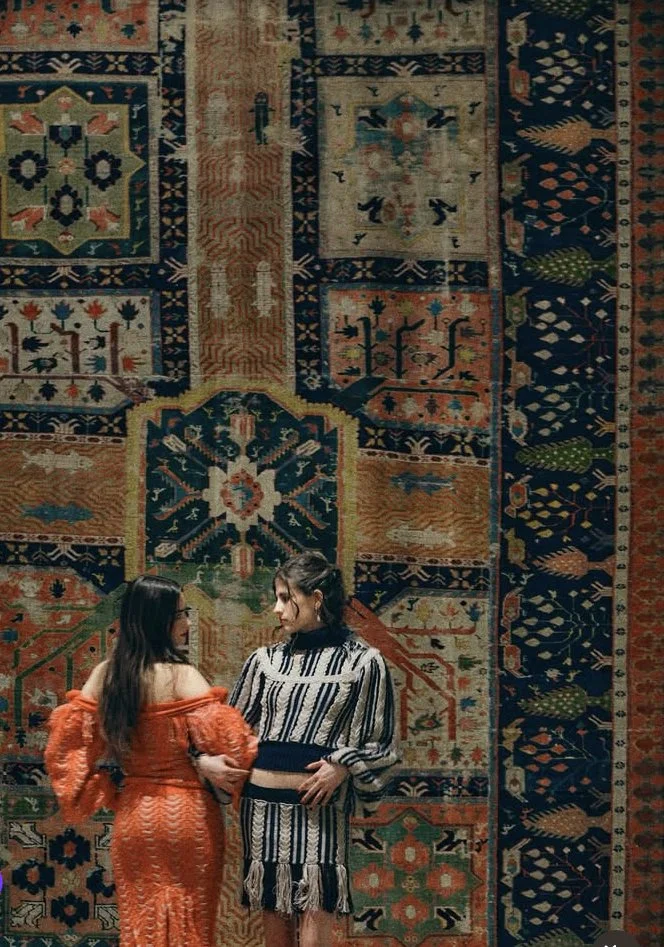
From there, the silhouettes unfolded with beautiful tension. Strong, sculptural shapes were softened by draped knits and fluid movement. An orange leather jacket paired with a mini skirt brought sharpness and confidence, while elsewhere delicate white lace revealed flashes of skin without ever feeling crude. The sensuality throughout the collection was intelligent, feminine but never fragile.
There were references everywhere to the Burrell itself. Frayed edges and loose threads recalled ancient tapestries slowly unravelling with time, as though the museum’s medieval textiles had come alive and stepped onto the runway. Turquoise tones echoed the faded richness of woven fabrics and stained interiors, reimagined for a contemporary woman. What made the styling especially successful was that, despite the theatricality of the presentation, the pieces still felt wearable individually. Knit mini dresses, balloon-sleeved high-neck jumpers, and sharply cut trousers grounded the fantasy in practicality.
The collaboration with silversmith Kyle Ferguson added another layer of depth. His heavy silver jewellery mirrored the armour and metalwork housed within the Burrell, tying the collection back into the museum’s permanent world. Chunky silver forms sat against soft knits and fluid fabrics with striking balance, reinforcing the show’s dialogue between strength and delicacy. The craftsmanship throughout, from textile manipulation to metalwork, felt deeply considered and unmistakably Scottish in its reverence for making.
That sense of community extended behind the scenes too. Flora and Kyle both won GSA awards that granted them residency access to the school’s facilities, allowing them to continue developing their practice within the institution that shaped them. Even the photographer was a GSA alumnus. The show became a portrait not only of one designer, but of Glasgow itself as a creative hub, collaborative, intergenerational, and fiercely supportive of its artists.
One of the evening’s most touching moments came through casting. While the show featured models from Model Team Scotland, Flora also chose to include her sister on the runway. She moved through the collection not just as a model, but almost as a muse, grounding the world-building in something deeply personal and intimate. In a show so concerned with character and storytelling, that emotional connection mattered.
And storytelling was everywhere. The programme itself was beautifully designed, capturing the essence of the collection before the runway had even begun. There was something undeniably reminiscent of Tim Walker in the atmosphere, not visually derivative, but similar in spirit. The collection created an entire world for these looks to exist within. You could feel Flora’s interest in costume and narrative woven through every silhouette, every texture, every movement.
What made the evening especially timely was its wider cultural resonance. At a moment when the fashion world is loudly debating whether fashion belongs within the realm of art, particularly in the wake of the recent Met Gala’s “fashion as art” discourse, this show offered a far more convincing answer than many of the conversations happening around it. Here, fashion was not borrowing the language of art for spectacle. It was in direct conversation with history, material, architecture, craft, and identity. It belonged in the museum naturally.
Perhaps that is why the announcement that the Burrell will stage an exhibition of Flora’s work in 2027 feels so significant. This runway did not feel like a one-off event. It felt like the beginning of something, not only for Flora, but for the Burrell itself as a living cultural space willing to engage with contemporary fashion in meaningful ways.
By the end of the show, as light continued to pour through the glass ceilings and silver jewellery caught the final traces of the afternoon sun, there was a rare sense that everyone in the room had witnessed a pivotal moment just before it fully crystallised. A young designer building a mythology of her own. A museum opening itself to new forms of storytelling. A city proving, once again, that creativity in Glasgow is never created in isolation, but in community.