

Ashley Collar is challenging what we think an academic is supposed to look like
Written and interviewed by Charlotte Lewis
Say the word academia and a particular image tends to cling: muted colours, sensible clothes, serious expressions, and an accent that sounds as though it has wandered straight off the set of Downton Abbey. Intelligence, particularly within academic spaces, has long been presented as something that should look a certain way. For Ashley Collar, that expectation is one she has spent much of her career questioning.
Online, she is better known as The Blonde Academic, a name that feels almost deliberately at odds with the traditional image of academia. Her world is pink, hyper-feminine and unapologetically playful, populated by fashion, beauty and the often-unspoken realities of working within higher education. Yet beneath the gloss is a serious interrogation of who gets to look intelligent, who gets to belong, and what an academic is supposed to be.
It is through this collision of femininity and academia that Collar has found her audience: people who, like her, have looked at the traditional image of intellectual life and wondered whether there was a place for them within it.
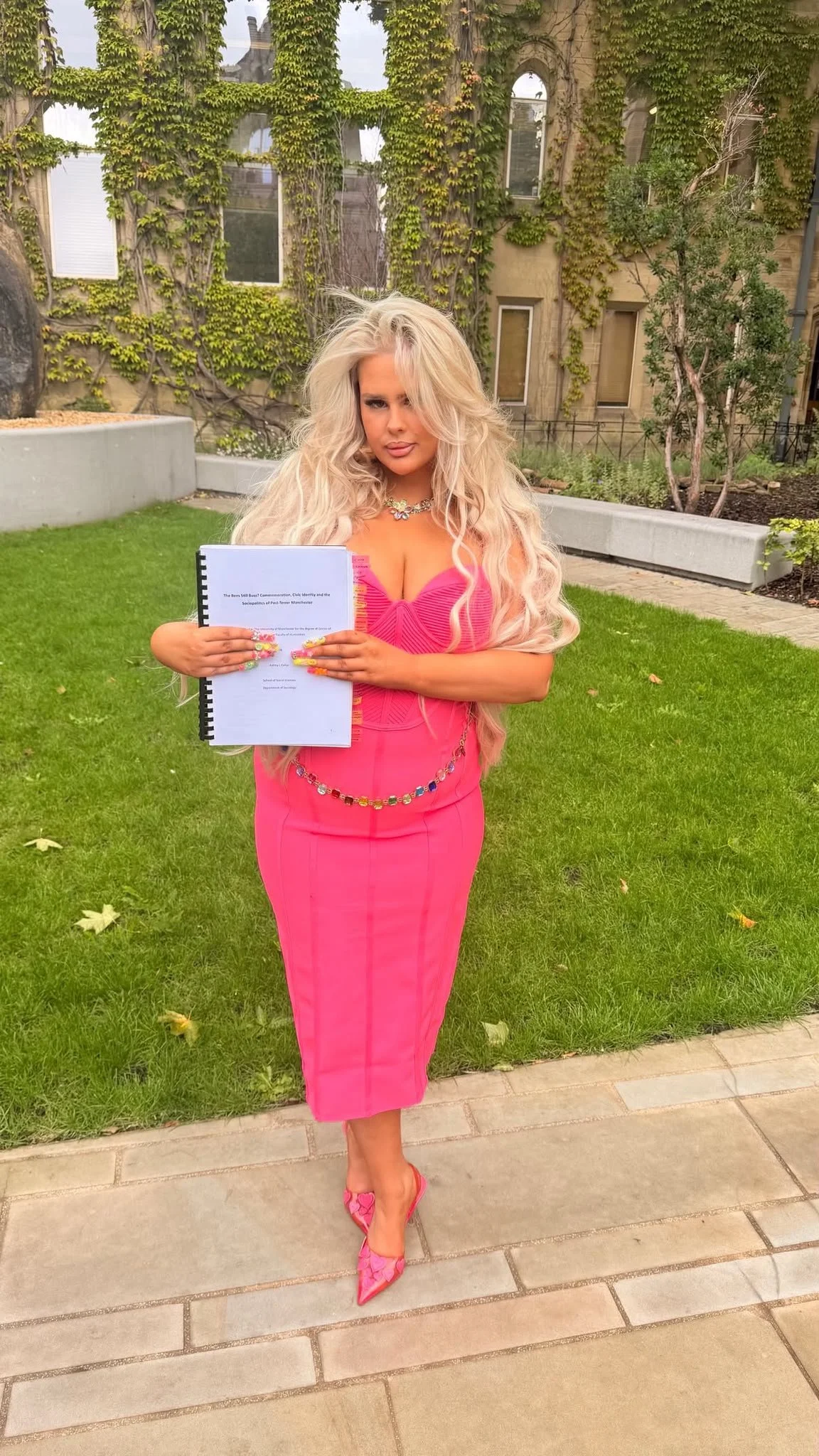
What began on TikTok has since grown into something much bigger. Collar had already begun sharing her academic life online when a friend suggested she try Instagram, telling her that her content might find an even wider audience there. She set up the account almost on a whim, only to gain nearly 10,000 followers within a month. What started as an experiment quickly became an alternative way of doing academia: one that allowed her to create her own opportunities, speak directly to an audience, and reach people who might never encounter academic work through a journal article or university lecture. In the process, she began to discover that there was an appetite for a different kind of academic voice, one that felt less distant, more accessible and, crucially, more human.
That desire to make her own space is rooted in her experience of entering higher education as the first person in her family to go to university. Like many people who grow up without a family history of higher education, Collar had largely constructed her expectations of university through popular culture. She imagined drinking, partying and making friends, and while she did have those experiences, she also discovered something that perhaps sounds obvious but was significant in her own journey: she had actually gone there to study.
Her relationship with university became considerably more complicated once she arrived. Collar grew up on a council estate in Manchester, in an area that had become heavily associated with crime and gang culture during the 1990s. The university she attended was just down the road from where she lived, yet physically close did not necessarily mean culturally familiar. On her first day at the University of Manchester, one of her first interactions was someone telling her, quite bluntly, that she “sounded common.”
It is the kind of comment that can stay with you, particularly when it arrives at the beginning of what is supposed to be an exciting new chapter. Collar found herself consciously masking her accent for a period of time, adjusting the way she spoke in order to fit into an environment that had already made it clear that the way she naturally sounded was not considered quite right. By the time she reached her Master's degree, however, she had begun to move in the opposite direction, choosing to embrace her accent rather than apologise for it.
That experience has informed much of the way she thinks about professionalism within academia. For Collar, the problem is not simply that certain people are made to feel unwelcome; it is that there are often very specific ideas about what a successful academic should look, sound and behave like. “There is a dulling down of personality, of appearance, of accents,” she explains. Her own style could hardly be further removed from that idea. She wears bright clothes, embraces hyperfemininity and is open about enjoying fashion and her own body, and she has increasingly come to see those things not as obstacles to her academic identity but as part of it.
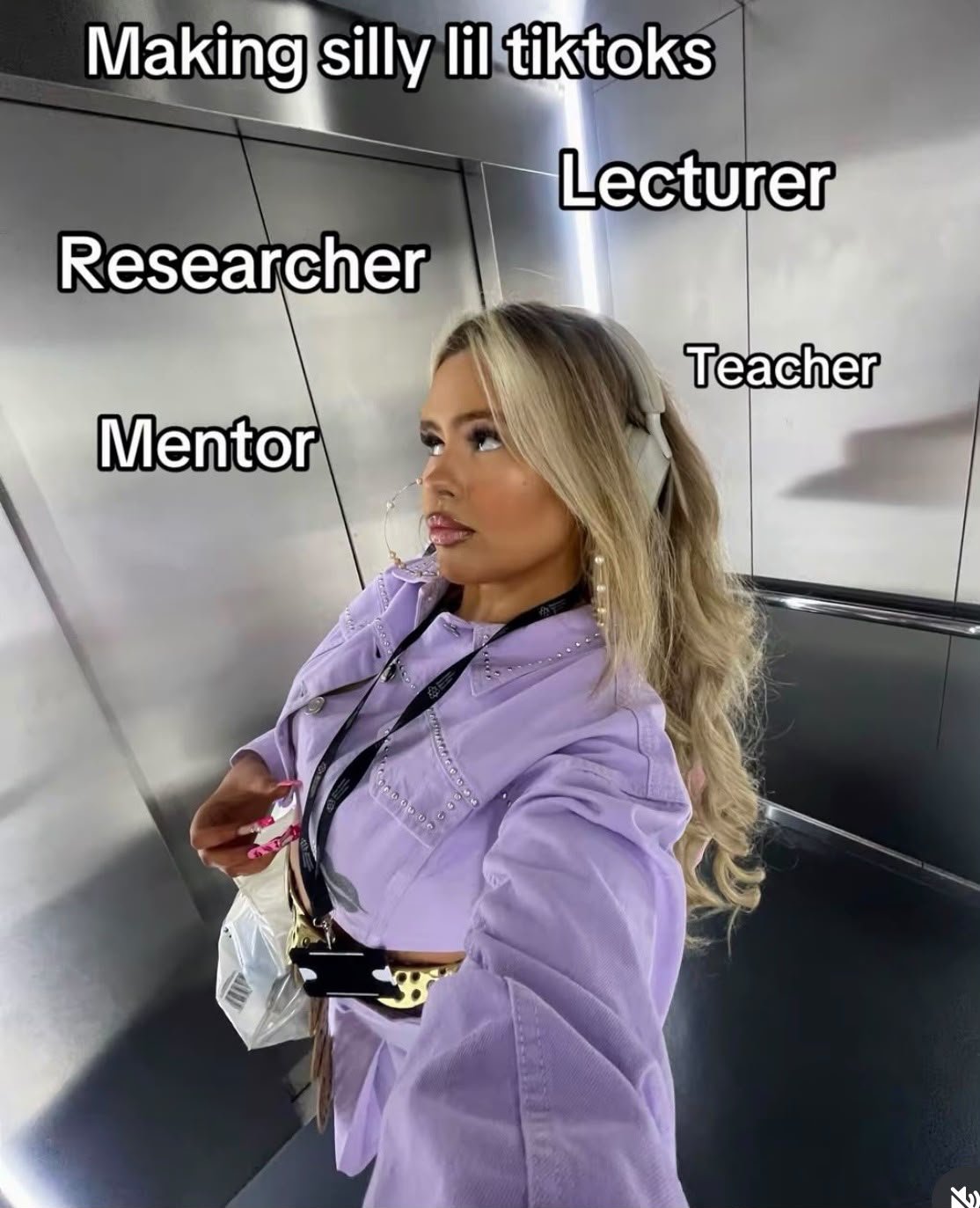
“Forget about all of that,” she says. “Just be who you want to be. Just be authentic.”
That authenticity is perhaps what has made The Blonde Academic so immediately recognisable online. The comparison to Elle Woods from Legally Blonde was not something Collar consciously engineered; it was her audience who began making the connection after one of her early TikToks showed her sitting at a very pink desk before revealing that she had completed a PhD. The joke resonated, and the comparison became a recurring part of her online identity. Rather than resisting it, Collar recognised that there was something there. Elle Woods, after all, is a character who begins by being underestimated because of the way she looks and behaves, only for those assumptions to be dismantled as the story progresses.
“I feel like she was quite misunderstood to begin with,” Collar says, explaining why the comparison has resonated with her. What she particularly connects with is the idea of the underdog who refuses to sacrifice her personality in order to prove her intelligence. Elle Woods does not become more capable by becoming less feminine, and that distinction is important to Collar, who has spent much of her own academic career negotiating the assumption that femininity and intelligence somehow exist at opposite ends of a spectrum.
It is a contradiction that extends far beyond the classroom. Collar believes that women's progression into leadership and traditionally male-dominated spaces has not necessarily dismantled the structures that determine which women are allowed to succeed comfortably. Instead, certain women are still more readily accepted than others, depending on their race, class, appearance and behaviour. She describes a particular tension around women who are visibly feminine, arguing that even extraordinary professional success does not necessarily protect women from being judged according to standards that have little to do with their actual work.
That judgement becomes particularly obvious online, where Collar has received comments sexualising her because of her appearance and suggesting that she has an OnlyFans account. For her, this is part of a wider issue surrounding the way women are expected to present themselves professionally. She questions why a woman being comfortable with her body should have any bearing on whether she is considered intelligent, credible or deserving of respect.
At the same time, Collar is conscious of the distinction between reclaiming femininity and inadvertently reinforcing the stereotypes attached to it. She admits that the relationship between the two is complicated, and that the way she dresses can inevitably be interpreted differently by different people. She is curvy, enjoys her body and sees no reason to hide it, but she also understands that this exists within a wider culture that has historically used women's appearance to undermine their authority.
For that reason, she is keen to stress that her feminism is not simply about dressing however you want and calling it empowerment. She describes herself as taking an intersectional approach to feminism and believes that conversations about equality have to extend beyond appearance into questions of power, behaviour and structural inequality. She is particularly conscious of the different standards applied to academics depending on their race and background, and says she feels a strong sense of solidarity with Black academics who are navigating those structures now.
This is also where her social media presence becomes more than simply an extension of her personal brand. Collar sees social media as a potentially powerful way of taking academic knowledge outside of the university, although she is careful not to romanticise it. She describes it as a double-edged sword: on one hand, platforms such as TikTok can make academic ideas accessible to people who would never read a journal article, but on the other, they can reproduce many of the same hierarchies and judgements that exist within academia itself.
She is particularly sceptical of the culture of achievement that can emerge online, where academic success becomes a carefully curated list of awards, publications and impressive credentials. Collar has seen content that presents academic life as a constant stream of extraordinary achievements, often accompanied by the message that success means being exceptional at an unusually young age. It is a version of academia that she actively dislikes because it leaves little room for the reality that most people's journeys are messy, uncertain and far less linear.
That belief feeds directly into her own understanding of success. Having recently completed her PhD, Collar could quite easily define success through qualifications, publications or professional achievements, yet she rejects that approach. “To me, success is an emotional feeling,” she tells me. “It's a feeling of happiness and of joy rather than, ‘Oh, I'm successful because I've published this.’”
Last year, she says, she was struggling mentally despite appearing successful on paper, and that experience changed the way she understood achievement. Now, she feels successful not simply because she has completed a PhD, but because she is doing things she is genuinely passionate about, from teaching and research to creating content and having conversations with people outside the traditional academic environment. Her qualifications are important, but they are secondary to the feeling that she is actually enjoying the life she has built.
That same philosophy informs what she hopes to give to her students. When I ask what she wants people to take away from being taught by her beyond the subject itself, her first answer is that they are capable of doing it, regardless of where they come from. Representation matters to her, particularly for students who might not immediately recognise themselves in the people standing at the front of the classroom, but so does the simple feeling of being listened to. She wants her students to feel that their experiences and opinions are taken seriously, something she believes universities often struggle to do consistently.
Her criticism of higher education is therefore not rooted in a rejection of academia itself. If anything, it comes from wanting universities to become better at the things they are supposed to do. Collar believes teaching should be at the centre of higher education, particularly at a time when universities are increasingly disconnected from the communities around them. Having worked at different institutions, she has seen first-hand how heavily research can sometimes be prioritised over teaching, despite students being fundamental to the existence of the university itself.
She is also concerned by the lack of meaningful engagement between universities and the communities surrounding them, arguing that there needs to be more outreach into schools, more opportunities for students to gain practical experience and more meaningful relationships between universities and the people living around them. Undergraduate degrees, she suggests, need to be reconsidered so that education is not simply something that happens inside a university building but something that has a tangible relationship with the wider world.
Her frustration is particularly evident when discussing international students, whom she feels can be treated as invisible despite contributing significantly to universities. For Collar, there is a fundamental question that higher education needs to answer: if research exists only to circulate among academics and never meaningfully reaches the people outside those institutions, then what purpose is it really serving?
It is this desire to challenge structures that has also shaped her ambitions beyond social media. Collar would eventually like to make a documentary, ideally one that explores the changing nature of higher education and the experiences of people whose stories are often overlooked, including doctoral students and early-career academics. Accessibility is important to her; she is frustrated by the extent to which information and culture are increasingly placed behind paywalls and believes that people from lower socioeconomic backgrounds should not be excluded from educational resources simply because they cannot afford access.
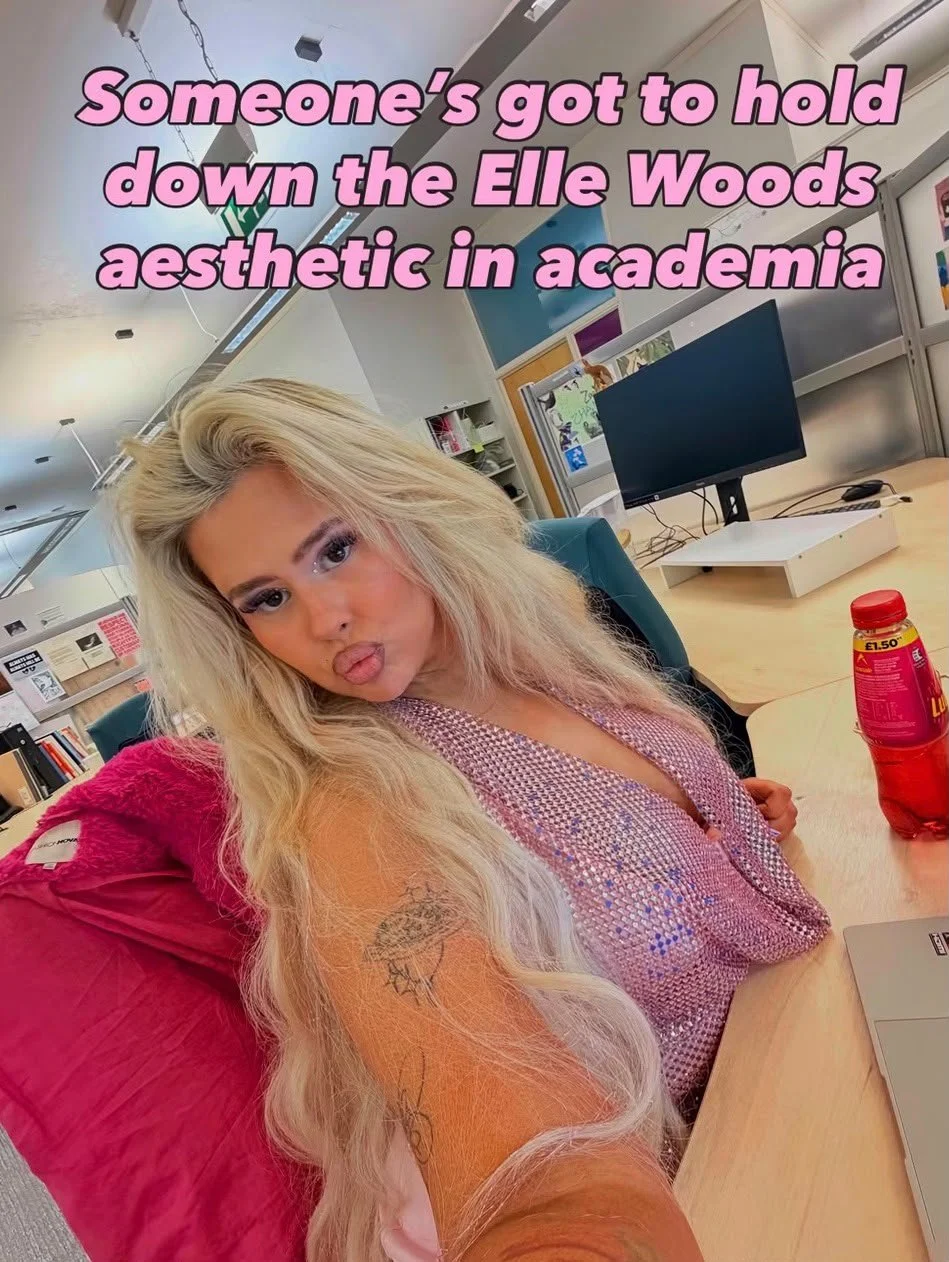
Image - @theblondeacademic - Instagram
The irony is that a woman who once felt compelled to soften her accent in order to fit into academia has now built a platform by refusing to soften anything at all. The blonde hair, the bright clothes, the femininity, the humour, the Northern accent: none of them are things to be edited out of the picture anymore. They are the picture.
When I ask what she ultimately wants her legacy to be, her answer is remarkably simple: authenticity. She speaks about her thesis in much the same way. It may not be filled with impenetrable language or the kind of academic jargon that can make research feel inaccessible, but, she explains, it felt authentic to her. Throughout our conversation, there is a sense that this is what Collar is ultimately trying to protect: the idea that intelligence does not need to arrive in a particular accent, body, outfit or personality in order to be taken seriously.
Perhaps that is also why she is so drawn to the current cultural moment around Zara Larsson. She speaks about Larsson with the same enthusiasm she brings to her own online work, particularly the joy of watching a woman be unapologetically herself while remaining vocal about what she believes in. For Collar, that kind of visibility matters. It offers an alternative to the familiar expectation that women, particularly successful women, must make themselves smaller, quieter or more serious in order to earn respect.
There is something quietly radical in refusing to choose between identities that have so often been presented as incompatible. Academic or feminine. Serious or playful. Northern or successful. Ambitious or joyful. Collar's answer to these false binaries is, essentially, why not be both?
Her final piece of advice is fittingly uncomplicated. “Just be authentic,” she says. Then, with a laugh, she adds: “Sparkle, sparkle, sparkle.”
Perhaps that is what makes The Blonde Academic such a compelling presence. In a world that has spent so long telling women what intelligence, success and seriousness are supposed to look like, Collar has decided to make room for something else: joy, femininity, personality and, above all, the freedom to be entirely yourself.
And perhaps academia could use a little more sparkle.