

Joan Didion’s South and West: Notes on Looking
By Charlotte Lewis
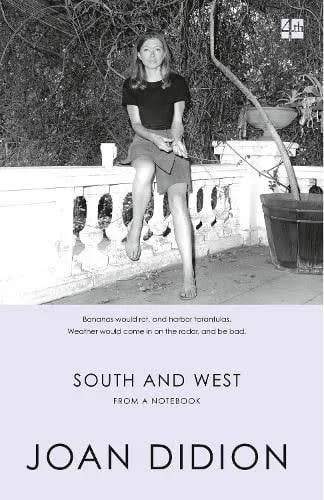
There is something particularly strange about reviewing South and West: From a Notebook, because it is not really a book in the conventional sense. There is no carefully constructed narrative, no argument that builds towards a neat conclusion, and very little of the satisfying structure we tend to expect from a finished piece of nonfiction. Instead, what Joan Didion gives us is a collection of fragments: observations, overheard conversations, descriptions of places and people, half-formed thoughts and seemingly insignificant details, gathered during a road trip through Louisiana, Mississippi and Alabama with her husband, John Gregory Dunne, in the summer of 1970, alongside a second collection of notes prompted by the Patty Hearst trial and her memories of California.
Yet somehow, from these fragments, a portrait begins to emerge.
Didion has always possessed an extraordinary ability to make the apparently insignificant feel worthy of attention. She notices the swimming pools at motels, the clothes worn by strangers, the quality of the heat, the particular light of a landscape, the things people say when they think they are simply making conversation. She records billboards, diners, family photographs and roadside encounters with the same careful attention that another writer might reserve for a major political event, because for Didion these details are rarely just details. They are evidence of something larger, a way into understanding the social structures, prejudices and peculiarities of a place without necessarily announcing that this is what she is doing.
This is what makes South and West so compelling, particularly in its observations of race, class and Southern identity. Didion travels through a part of America in which history appears to be unusually close to the surface, where family lineage and social position are understood as part of an almost instinctive hierarchy, and where the past has not been neatly separated from the present. She is fascinated by the ways in which people speak about themselves and their communities, often revealing far more than they seem to realise in the process.
Her description of New Orleans is one of the clearest examples of this. She writes of the city's “preoccupation with race, class, heritage, style, and the absence of style”, contrasting this with the Western tendency to deny or deliberately avoid such distinctions. In New Orleans, these divisions are not necessarily hidden or uncomfortable subjects; they are part of the social vocabulary, woven into everyday conversation and used to determine where people belong in relation to one another. There is something almost childlike about the cruelty Didion observes, but also something deeply revealing in the fact that these distinctions are so ordinary to the people living within them.
Didion's great strength is that she does not always tell us how we are supposed to feel about what she encounters. Instead, she allows people to reveal themselves through their own words, and this can be far more unsettling than a straightforward piece of condemnation. A white owner of a Black radio station in Meridian, Mississippi discusses the importance of Black spending power while assuring Didion that the Ku Klux Klan has lost much of its former influence; elsewhere, she encounters a framed slave deed alongside a Christmas card from the Nixon White House, while a child at a Howard Johnson's appears wrapped in a Confederate flag pool towel.
The details are extraordinary, but what makes them linger is the almost casual manner in which they are recorded. Didion does not stop the journey to explain the significance of every object or conversation, and she rarely gives us the comfort of a clear moral conclusion. She simply writes down what she sees and allows it to sit there, uncomfortable and unresolved.
That detachment can be frustrating, particularly when reading the book from the perspective of the present. There are moments when you want Didion to ask another question, to challenge someone more directly or to stay with an observation for longer rather than moving on to the next motel, restaurant or roadside town. It is tempting to look at the racism and class divisions she encounters and ask what exactly we are supposed to do with them, especially when the book's publication in 2017 inevitably encouraged comparisons between the America Didion observed in 1970 and the America that had just elected Donald Trump.
There are certainly uncomfortable parallels, but I am not convinced that South and West needs to function as a political explanation of contemporary America, and expecting it to do so perhaps misunderstands what makes the book interesting in the first place. These were never intended to be a finished political text. They are notebooks, and notebooks are valuable partly because they capture thought before it has been organised into an argument. We are seeing Didion notice something before she has necessarily decided what it means, and there is something unusually intimate about being allowed into that stage of the process.
This unfinished quality is perhaps the most fascinating thing about the book. We are accustomed to encountering writers once the messy process of thinking has been transformed into polished prose, when contradictions have been resolved and an argument has been carefully constructed so that every sentence seems to arrive exactly where it should. South and West gives us something closer to the raw material, allowing us to watch Didion collect the observations that would eventually become something larger.
This becomes particularly apparent when the book moves from the South to California. The “California Notes”, originally prompted by the Patty Hearst trial, gradually become less about Hearst herself and more about what the trial has stirred up in Didion: memories of Sacramento, thoughts about her childhood, her family and the women she grew up around, as well as the particular mythology of the American West that shaped her understanding of herself and the place she came from. A contemporary event becomes a route into personal history, and personal history becomes a way of thinking about the larger culture.
The contrast between the South and the West is therefore more interesting than a simple geographical distinction. The South that Didion encounters appears deeply rooted in its history, with family, ancestry and inherited social position continually resurfacing in everyday life, while California represents something closer to the American fantasy of reinvention, a place where the past can supposedly be abandoned in favour of whatever comes next. One is preoccupied with where you came from; the other with the possibility of becoming someone else.
Didion, of course, is fascinated by both.
This is also where the pleasure of reading her notebooks becomes difficult to separate from the pleasure of simply watching her mind work. She has an extraordinary eye for the tiny details that make a place feel real, and there is something almost voyeuristic about the experience of reading these notes, as though we have been quietly allowed into hotel lobbies, family homes, lunches and roadside conversations where nobody imagined that their words would eventually become part of Joan Didion's literary archive.
I could happily read hundreds of pages of Didion describing hotel swimming pools, partly because of the pleasure of her prose and partly because of what those swimming pools represent. She understands that a place is often revealed through its most mundane features, through the particular colour of a motel towel or the clothes worn by a man sitting at a metal picnic table, through the signs beside a highway and the things people choose to display without thinking of them as political statements. Her writing makes these things feel almost absurdly significant, but the significance is there because culture is built out of precisely these ordinary details.
There is a temptation, when discussing Didion, to concentrate exclusively on the beauty of her sentences, but doing so can obscure the more complicated question of what she is actually doing with her gaze. She was an exceptionally privileged observer, moving through places and communities that were not her own and recording people whose lives she could leave behind at the end of the journey. Her detachment is part of her appeal, but it is also something worth interrogating, particularly when the subjects of that observation include poverty, racism and the lingering consequences of slavery.
The book does not entirely resolve that tension, and perhaps it shouldn't. Didion's position as an outsider is precisely what allows her to notice certain things, while also meaning that there are things she cannot fully understand. What makes the notebook valuable is not that she arrives with complete knowledge, but that she records the contradictions she encounters and, in doing so, exposes the limits of her own perspective alongside the absurdities of everyone else's.
More than fifty years after these notes were written, that quality feels strangely relevant. Not because South and West contains a secret explanation for contemporary America, or because the observations can be neatly mapped onto the political landscape of today, but because it demonstrates how much of history is contained in things that initially appear too ordinary to matter. A comment made over lunch, a photograph hanging on a wall, a flag beside a swimming pool, a story someone tells about their family: none of these things necessarily announce themselves as historical evidence while they are happening, but together they form the texture of a culture.
Perhaps that is why I found the book so satisfying despite its incompleteness. Didion does not give us a grand theory of America, and she does not attempt to tie the contradictions she encounters into a neat conclusion. Instead, she gives us the material from which conclusions might eventually be formed, asking us to pay attention to the things that are easy to overlook and to understand that the ordinary is often where the political becomes most visible.
There is something especially appealing about that now, when cultural commentary often seems to demand an immediate position on everything. Didion's notebooks occupy the space before the opinion, when an observation is still an observation and the meaning has not yet been decided. She allows herself to be curious, to be uncertain, occasionally to be wrong, and to follow an idea simply because something about it has caught her attention.
That, ultimately, is what makes South and West such an absorbing read. It is not necessarily Didion's most complete or politically rigorous work, and it does not offer the intellectual satisfaction of a fully developed argument, but it offers something else: an unusually intimate glimpse into the process by which a writer learns how to see.
The book is about the South and the West, but it is also about memory, class, race, inheritance and the stories people construct around the places they come from. More than anything, however, it is about observation, about the strange discipline of paying close attention to the world and trusting that somewhere within its smallest details there might be a larger story waiting to emerge.
Didion's genius was never simply that she could write a beautiful sentence. It was that she understood how much a beautiful sentence could contain, and South and West is perhaps most rewarding when we stop asking it to give us answers and instead allow ourselves to sit with what she noticed.
Sometimes looking closely is the beginning of understanding, even if it is not the whole of it.